

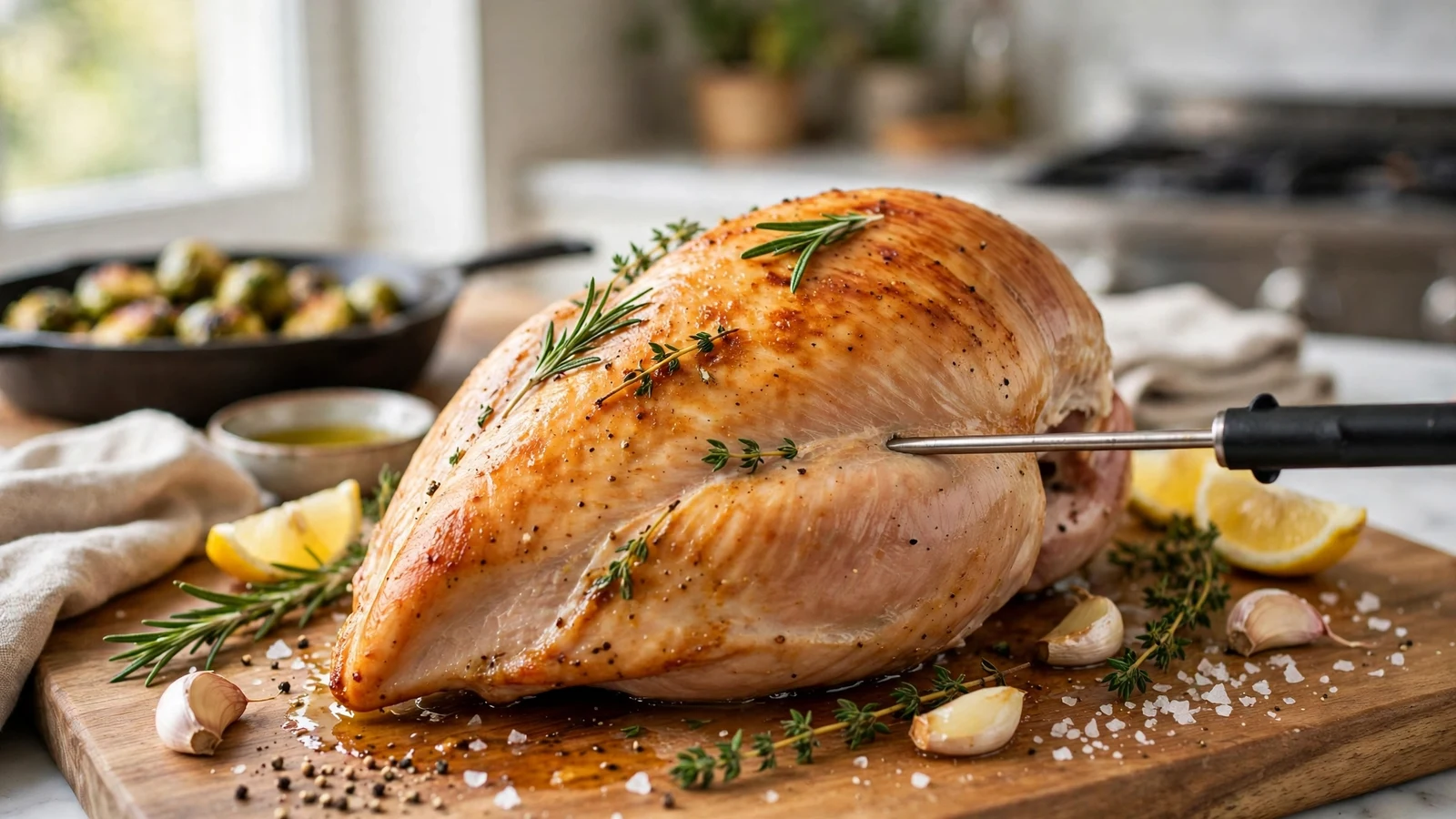
Figuring out where to put meat thermometer in turkey breast can make the difference between serving a juicy centerpiece and suffering through dry, stringy poultry. Thanksgiving dinner hangs in the balance when you stand over the roasting pan, digital probe in hand, wondering how deep to push the metal. Cooking a whole bird or just a standalone breast requires precision because white meat dries out faster than dark meat.
Mastering this technique guarantees safe eating without sacrificing flavor or moisture. This guide walks you through exact placement angles, thermometer types, and temperature milestones to nail your holiday roast every single time.
Anatomy of the Breast and Probe Placement Basics
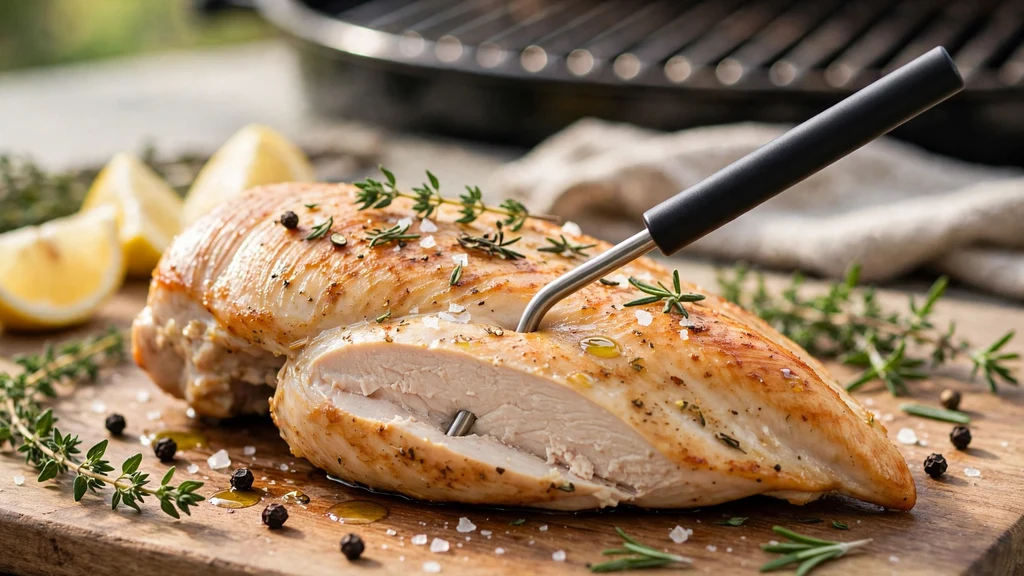
The thickest part of the meat holds the key to accurate cooking measurement. When you look at a raw turkey breast, the upper pectoral muscle slopes upward toward the wing joint and tapers off near the neck. You want to slide your metal probe directly into the center of this dense mass, avoiding any direct contact with the skeletal structure beneath.
Hitting bone throws off your reading completely. Bone conducts heat much faster than muscle tissue, meaning a probe resting against the clavicle or breastbone will display a falsely high temperature while the surrounding flesh remains dangerously undercooked.
Aim for the meatiest zone, roughly midway between the wing and the cavity opening, keeping the tip buried in the middle of the flesh. If your probe pushes all the way through to the cavity or hits the bone, pull it back slightly and redirect your angle.
Choosing the Right Tool: Digital vs. Dial Thermometers
Not all kitchen gauges are created equal when roasting poultry. A traditional analog dial thermometer works in a pinch, but digital models offer unmatched speed and accuracy for home cooks. Understanding your specific device helps you secure reliable internal temperature readings.
| Thermometer Type | Response Time | Best Use Case |
|---|---|---|
| Digital Instant-Read | 2 to 5 seconds | Checking doneness at the very end of cooking |
| Leave-In Probe | Continuous | Monitoring entire cook time with oven alarms |
| Dial Oven-Safe | 30 to 60 seconds | Staying in the bird throughout the roasting process |
Digital options feature a narrow metal stem with a tiny sensing element located right at the tip. This design means you only need to insert the probe a short distance to get an accurate number, unlike dial versions that require you to push the stem in two inches or more to reach the measurement zone marked by the dimple stem.
Avoiding Common Placement Mistakes
Countless holiday dinners are ruined by poor probe technique. One major error involves inserting the tool from the top skin side straight down toward the ribs. This positioning makes it almost impossible to judge depth accurately, and gravity can cause the heavy gauge to slide further in or slip sideways.
- Never insert the probe into the skin cavity or directly into a pocket of stuffing.
- Avoid placing the metal too close to the surface, which measures ambient oven heat rather than meat doneness.
- Do not let the probe touch the ribcage, cartilage, or any turkey bones.
- Refrain from wiggling the tool excessively, as this lets precious juices escape down the hole.
- Don’t rely solely on the pop-up plastic timers that come pre-installed in store-bought birds.
Approaching from the side, entering horizontally parallel to the cutting board, provides much better stability. This side-entry method keeps your hand safely away from hot steam while letting you position the tip precisely in the deep center of the breast.
Understanding Safe Target Temperatures
Food safety standards dictate that poultry must reach a specific thermal threshold to eliminate harmful bacteria. The United States Department of Agriculture recommends pulling your bird when it hits 165 degrees Fahrenheit at the deepest point. However, smart cooks often utilize carryover cooking to their advantage.
When you remove a large roast from the hot oven, residual heat continues to cook the interior for several minutes. Pulling the bird when the breast registers 160 degrees and letting it rest under a loose foil tent allows the temperature to climb safely to the target zone while keeping the juices locked inside the muscle fibers. For comprehensive guidelines on safe food handling, consult the USDA Food Safety and Inspection Service.
Techniques for Bone-In vs. Boneless Roasts
Cooking a bone-in turkey breast requires a slightly different approach than handling a boneless, rolled roast. With a bone-in cut, the sternum runs down the center, creating two distinct halves of meat. You must slide your probe into the thickest portion of one half, angling it away from the central bone structure.
Boneless turkey roasts, often tied with kitchen twine to maintain an even cylinder shape, offer more uniform thickness. You can insert your instant read thermometer straight into the center of the cylinder from the end or the top, provided you avoid the netting or string. Because boneless cuts lack structural bones, they often cook slightly faster than bone-in varieties, making frequent spot-checks essential during the final half-hour in the oven.
Managing Leave-In Probes Versus Instant Read Models
Deciding whether to leave your gauge in the bird throughout the entire roasting cycle changes how you manage your kitchen workflow. A leave-in digital probe connects via a heat-resistant cord to an external base unit, letting you monitor progress without opening the oven door and losing valuable heat.
Insert the leave-in probe before the pan goes into the oven, making sure the wire won’t get pinched by the door seal. If you prefer a traditional instant read model, save it for the final stages of your turkey cooking routine.
Begin testing about 30 minutes before the estimated finish time. Pop the oven door open, quickly insert your device into the meat, and wait a few seconds for the digital display to settle on a final reading before closing the door again.
The Critical Role of Resting Time
Pulling your roast out of the heat source is only half the battle. Slicing into a piping-hot turkey breast immediately results in a dry disaster because high heat forces muscle fibers to contract and push all their moisture outward toward the edges.
Allowing the meat to rest undisturbed for 20 to 30 minutes gives those tight muscle fibers a chance to relax and reabsorb their flavorful juices. Cover the platter loosely with aluminum foil to trap warmth without creating steam that ruins the crispy skin. During this resting window, the internal temperature will continue to rise by about 5 degrees, completing the cooking process safely and naturally.
Troubleshooting Hard-to-Read Thermometers
Sometimes your equipment acts up at the worst possible moment. If your digital screen fluctuates wildly or refuses to register a higher number even after hours in the oven, you might be dealing with a low battery or a damaged sensor wire.
Keep a backup instant-read device in your kitchen drawer so you never get stuck guessing. If you suspect your primary gauge is inaccurate, test it in a cup of boiling water, which should read exactly 212 degrees Fahrenheit at sea level, or in ice water, which should register 32 degrees. Calibrating or replacing faulty gear ensures you never serve undercooked poultry to your dinner guests.
Frequently Asked Questions
Should I leave my meat thermometer in the turkey while it cooks?
You can leave specialized oven-safe or wired digital probes in the bird throughout the entire roasting process. However, standard instant-read models should only be inserted at the end of the cooking cycle to check doneness and removed immediately afterward.
Is a turkey breast done at 160 or 165 degrees Fahrenheit?
The safe minimum internal temperature for poultry is 165 degrees. Many chefs remove the meat at 160 degrees and let it rest, as carryover cooking will safely raise the final internal temperature while preserving valuable moisture.
Can I check the temperature of a turkey by cutting it open?
Cutting into the meat ruins your roast by letting all the flavorful juices escape prematurely. Using a calibrated digital thermometer is the only reliable, food-safe way to verify doneness without destroying the presentation.
Why does my thermometer read different temperatures in different spots?
Different parts of the bird cook at different rates due to varying thickness and fat distribution. The wings and outer edges heat up faster than the dense center of the breast, which is why accurate placement in the thickest part is crucial.
Conclusion
Mastering where to put meat thermometer in turkey breast transforms holiday cooking from a guessing game into a predictable science. By targeting the thickest part of the meat without hitting bone and respecting proper resting times, you ensure a safe, juicy meal for everyone at the table. Grab your digital probe this season and cook with total confidence.