

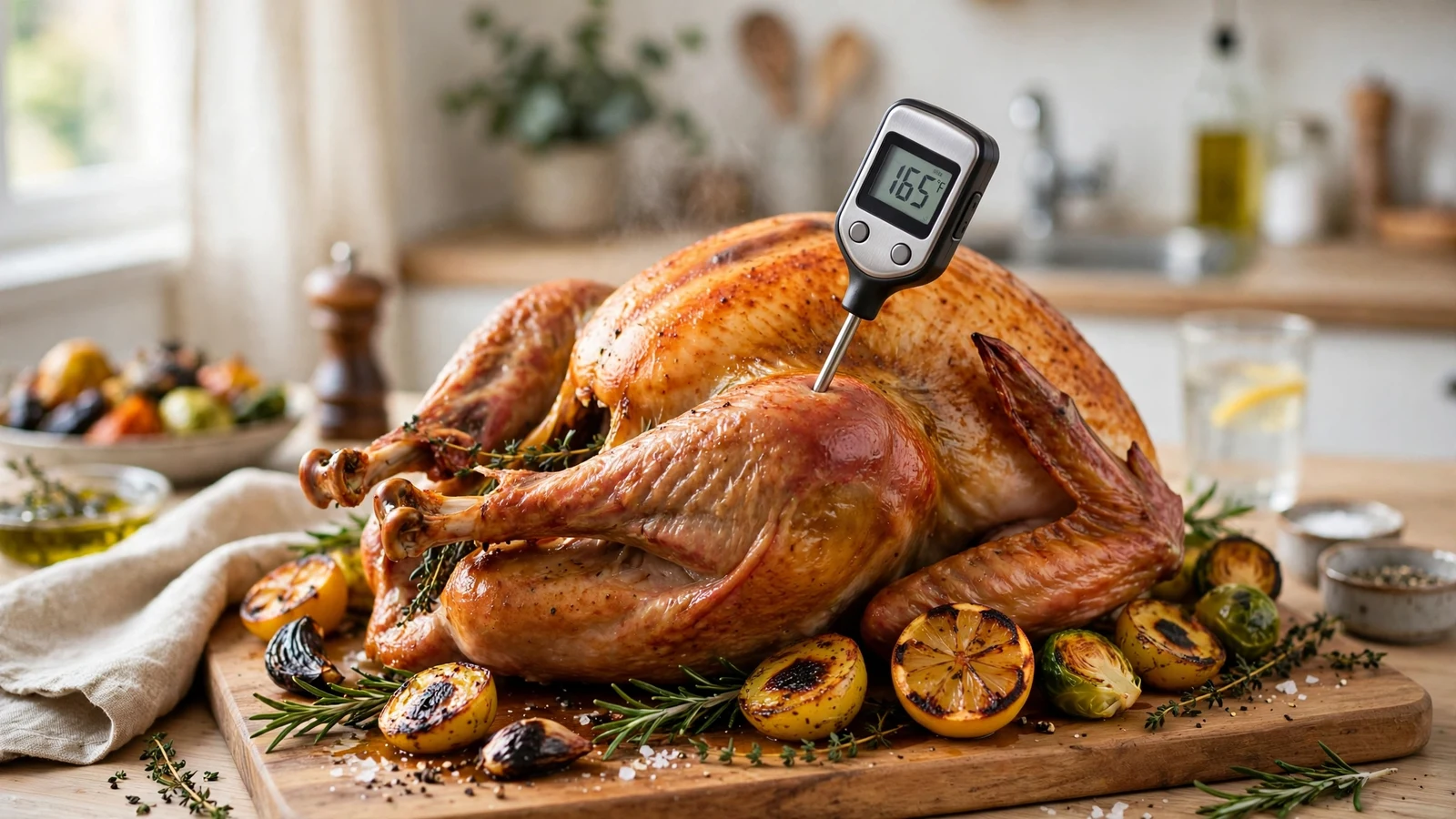
Getting dinner right comes down to a few precise moments, and knowing how to take turkey temp with a meat thermometer is the single best way to avoid serving a dry bird to your guests. Nobody wants to guess if the centerpiece of the holiday table is ready, and relying purely on clock time often leads to disaster because every bird cooks a little differently.
Understanding USDA Food Safety Guidelines

Food safety is the absolute priority when roasting a whole turkey, and the USDA food safety standards provide the benchmark for success. Pathogens like salmonella demand precise heat to destroy, meaning you cannot afford to guess based on skin color or juices running clear. The official standard states that poultry must reach a minimum internal temperature of 165 degrees Fahrenheit to be considered completely safe to eat.
However, professional cooks often pull a large bird slightly earlier because residual heat continues cooking the meat while it rests. If you measure correctly, you avoid both the danger of foodborne illness and the heartbreak of stringy, overcooked breast meat. Keeping a close eye on the thermometer eliminates the guesswork that ruins so many holiday meals.
Choosing the Right Thermometer for the Job
You cannot rely on the plastic pop-up timer that comes embedded in many grocery store birds. Those little red gadgets are notorious for malfunctioning or triggering far too late, resulting in chalky, dried-out meat. Investing in reliable thermometers changes your entire approach to roasting.
Digital instant-read models provide a reading in just a few seconds, letting you check multiple spots quickly without letting all the heat escape the oven. Dial thermometers still exist, but they respond slowly and require frequent calibration in ice water. A wired digital probe thermometer allows you to monitor progress continuously without opening the oven door at all.
- Instant-Read Digital: Fast, highly accurate, and ideal for quick spot checks at the end of cooking.
- Leave-In Probe: Stays in the bird the entire time in the oven, sounding an alarm when the target is hit.
- Dial Thermometer: Traditional analog option, but requires manual calibration and takes longer to settle.
Finding the Thickest Part of the Meat
Placement matters just as much as having a working device, and where you insert the probe dictates your reading. You want to target the densest muscular areas of the bird while completely avoiding direct contact with any bone. Touching bone gives you a falsely high reading because bone conducts heat much faster than flesh.
The inner thigh muscle is the primary spot to check, but make sure the tip doesn’t punch all the way through into the hollow cavity. You should also check the thickest portion of the breast, which cooks much faster than the dark meat and dries out easily. If you only check one spot, you run the risk of carving into undercooked meat elsewhere.
| Anatomical Area | Target Temperature | Why It Matters |
|---|---|---|
| Deep Thigh Muscle | 170 degrees Fahrenheit | Dark meat requires higher heat to break down connective tissue. |
| Thickest Breast Portion | 165 degrees Fahrenheit | Leans out quickly; overcooking ruins the texture. |
| Center of the Stuffing | 165 degrees Fahrenheit | If you stuff the bird, the filling must reach safety standards too. |
Step-by-Step Technique for Insertion
Executing the check requires steady hands and a bit of care so you don’t burn yourself on the hot roasting pan. Open the oven door, pull the rack out slightly to get a better angle, and shield your hands with heavy mitts.
Hold the digital probe like a dart and slide it smoothly into the chosen spot without wiggling it around too much. Wait about five to ten seconds for the digital display to stabilize completely before recording the number. If the reading falls short, close the oven and give it another fifteen minutes before testing again.
Balancing Dark Meat and White Meat Temperatures
One of the great culinary challenges of roasting a whole bird is the physiological difference between its parts. The breast meat dries out rapidly above 165 degrees, whereas the dark meat in the legs and thighs actually benefits from reaching 170 to 175 degrees because it breaks down tough collagen.
Many experienced home cooks tent the breast with foil during the final hour of roasting to slow down its cooking speed. This simple trick lets the thighs catch up, ensuring you get juicy white meat alongside tender, fully rendered dark meat.
Why Resting is Non-Negotiable
Pulling the bird out of the hot oven does not mean the cooking process has completely stopped. Residual heat continues to drive internal temperatures upward by about five to ten degrees during the resting period.
If you slice into the bird immediately, all those delicious natural juices will pool onto your cutting board instead of staying locked inside the fibers. Let the roasted bird rest uncovered on a carving board for at least twenty to thirty minutes before you even pick up a knife.
Common Mistakes to Avoid
Even with the best tools, simple procedural errors can ruin an otherwise perfect meal. Avoid letting the metal tip rest against the backbone or the pelvic girdle, as this will trick you into thinking the whole bird is done when the meat is still raw.
Another frequent blunder involves checking too early in the roasting cycle before the heat has properly penetrated the core. Keep track of your cooking time estimates, but always let the thermometer have the final say over the kitchen clock.
Frequently Asked Questions
How do you check turkey temperature with a meat thermometer?
Insert the probe into the thickest part of the inner thigh without touching bone, or into the deepest part of the breast. Wait a few seconds for the digital display to stabilize and read the number.
Is a turkey done at 165 or 180 in the oven?
The breast meat is safe and juicy at 165 degrees Fahrenheit. However, the dark meat in the thighs tastes better when cooked to 170 or 175 degrees to break down connective tissue.
Can you leave a meat thermometer in a turkey while it cooks?
Yes, if you use an oven-safe leave-in digital probe thermometer. Standard instant-read models should not be left inside a hot oven because the high heat can damage their internal electronic components.
How long will a 20 lb turkey take at 350 degrees?
An unstuffed twenty-pound bird generally takes roughly four to four and a half hours at 350 degrees Fahrenheit. Always verify doneness with a reliable thermometer rather than relying purely on time.
Conclusion
Mastering this simple culinary skill ensures your holiday centerpiece turns out safe, juicy, and flavorful every single time. By ditching the unreliable pop-up timers and trusting a proper digital probe, you take total control of your kitchen results. Grab your tools, check those critical spots carefully, and enjoy a wonderful meal with your family.